Climate change has become evident, and its urgency has never been greater. In 2024, we saw the average global temperature surpass the 1.5°C mark above pre-industrial levels. According to IPCC in 2022, every increment in temperature above this mark shall significantly impact human systems, and terrestrial, freshwater and coastal ecosystems. To tackle this problem, the world under the Paris Agreement pledged to reduce GHG emissions by 45% in 2030 and achieve full carbon neutrality by 2050. Responding to this Agreement, India has acted on mitigating climate change by pledging to be Net Zero by 2070. However, achieving carbon neutrality at current times seems like a distant goal.
To meet this global commitment, Higher Education Institutions (HEIs) are uniquely positioned to accelerate climate action. Globally, over 1,000 HEIs from 68 countries have committed to rally leadership and take bold action towards net zero under the UN Environment Programme, Environmental Association of Colleges and Universities & Second Nature’s powered ‘Race to Zero for Universities and Colleges’ (Race to Zero, 2024). These HEIs have pledged to halve emissions by 2030 and to reach net zero by 2050.
In India, in 2023, the government launched the ‘University Grants Commission’s (UGC) U75: Not Zero-Net Zero’ initiative in synergy with the Race to Zero initiative, aimed to encourage HEIs in the country to participate in transitioning towards carbon neutrality by 2030. The initiative involves collaboration among government institutions such as the University Grants Commission (UGC), All India Council for Technical Education (AICTE) and think-tanks such as the Green TERRE Foundation. Further, India’s National Education Policy (NEP) 2020 directs educational institutions to integrate environmental sustainability into their curriculum and operational strategies. Various sections of NEP, such as 4.23, 4.24, 4.27, and 17.2 (and many more), emphasise the need for sustainability education and campus- based climate actions, making HEIs pivotal in the national climate adaptation efforts.
HEIs have a complex structure and act as mini-cities comprising various buildings such as classrooms, laboratories, offices, dining areas, and residential areas. Like any other organisation, HEIs contribute to greenhouse gas (GHG) emissions through energy use, mobility, water, waste, and procurement (at an average HEIs accounts for 2-3% of an entire country’s emission); however, at the same time, they have added the responsibility of being catalysts for wider societal change as they have the power to shape the values and capabilities of future leaders.
The project aims to develop a methodological approach for self- accounting and reporting and taking informed decisions on their sustainability approaches and transition to Net Zero. As the rate of transition by an HEI is influenced by factors such as institutional policy, stakeholder behaviour and physical infrastructures such as solar roof tops, etc. we are designing a framework. The framework is designed to move beyond “rating-only” approaches and instead support institutions with a structured, data-driven pathway to assess emissions, plan interventions, and track progress towards carbon neutrality. We hope our work shall help HEIs to:
WORKING PAPER
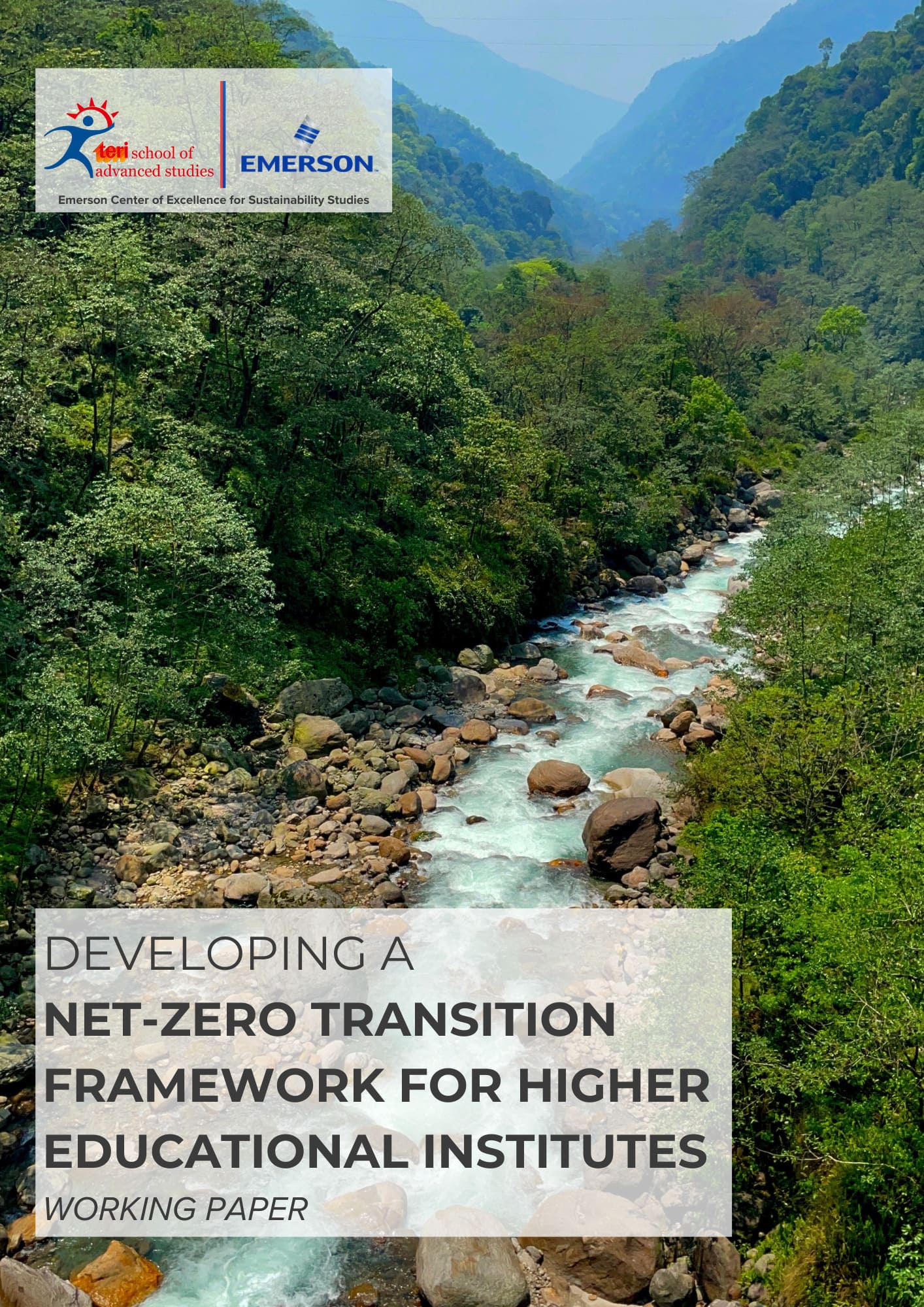 A strategy paper outlining
a co-produced framework
to help higher education
institutions transition to
net-zero by targeting
infrastructure, behaviour,
and policy across key
emission sectors.
It positions campuses as
carbon-neutral hubs that
drive climate action
through integrated
changes in operations,
curriculum, and research.
|
HEI CASE COMPENDIUM BOOK
 The case compendium
brings together 16
research-informed case
studies from Indian and
international HEIs,
documenting practical
approaches to net zero
transitions across energy,
water, waste, mobility,
green infrastructure, and
sustainability-led
research. It aims to serve
as a major resource for
institutions seeking to
operationalise climate
action through campus-
wide systems,
governance, and
curriculum.
|
OUTREACH ACTIVITIES
 |